What a surprise I had today when I go to grab a can of Sprite with my lunch and just before I take it to the till, what do I notice on the shelf? A Bulbasaur-variant Ocean Bomb!
What is Ocean Bomb?
Ocean Bomb is a Taiwanese sparkling water manufacturer that claims to source its water from depths of 750m under the seas of Asia.
They decorate their cans with adorable characters! Some of these I don’t actually know. There is a cute car, a little chick surrounded by a pink rabbit called Piske & Usagi… any ideas? However, they do happen to have a whole Pokémon range! The variants include Bulbasaur, Charmander, Squirtle, Pikachu, Snorlax Jigglypuff and Master Ball. I also hear a Psyduck one is floating about, but it might be a Taiwan-only one for now.
The Bulbasaur version is apple flavoured and tastes a little like Appletiser. If you want to try it and live in the UK, I found it (and the Snorlax one) at Asian-fusion restaurant East Street in Manchester! However, I bet its in other places… let me know if you see them, I’d love to try the other flavours! Gotta taste ’em all!
One of my favourite TV shows growing up was the PokéWorld Talent Contest, which was designed to compliment the Eurovision Song contest. Both have been been running since 1956. In this competition, Pokémon are selected to represent each country in a series of semi finals, until they are whittled down to just forty. These acts perform for one night of dazzling entertainment and viewers vote for their favourite acts. Whichever country wins the competitions hosts it next year! In this series of posts, I want to highlight some of my favourite winners from over the years.
The Competition
The competition I am covering in this entry is the 2003 show hosted in the, at the time, new sovereign state of Timor-Leste. Hosted in the capital of Dili by Dili Televisão, this was the 48th edition of the show. The competition was preceded by a meal, which consisted of the country’s national dish: Ikan Pepes (fish steamed in a chili sauce and wrapped in banana leaves), and the performance area was crocodile themed, to reflect the country’s national animal.
The host country’s entry was memorable, comprising Raboot Jose da Costa, who showcased his incredible geography knowledge by listing over fifty countries and their national drink from memory as part of a song. The show’s runners up were Garbodor Photographer, Maria Cabera, who represented Colombia by presenting a series of photographs that captured the show’s theme of ‘Magical Rendezvous’; and Banette Historian, Carolina Benitez, who represented Paraguay by recounting a horror-romance story that featured Paraguayan mythology creature, the Luisón.
The Winning Act
Santiago Pérez and Sofía Pérez dancing the Jarabe Tapatío. Image Credit: Shizuka Hanari
The winners of the PokéWorld Talent Contest were Bulbasaur Santiago Pérez and his partner Sofía Pérez, representing Mexico. This couple danced the traditional Mexican dance, Jarabe Tapatío, which is also known as the Mexican Hat Dance. The Jarabe Tapatío was originally a dance of love and courtship, and the Pérez’s version was filled with romance and heart—demonstrated in rather visually near the final stage of the act, where a confetti canon was fired to fill the stage with red paper leaves that had been cut into heart shapes. They were accompanied by a mariachi group and wore the traditional dress (a china poblana outfit for Sofía and a charros for Santiago).
In their home life, Santiago and Sofía live on an avocado farm with their two children, where the family helps test the ripeness of this fruit. Dance and music has been a big part of their family life, and their trainer has dreams of opening a Pokémon dance studio to help spread the joy of traditional Mexican dancing.
Fruit can be given periodically as a treat. Image credit: Takamizawa Usui.
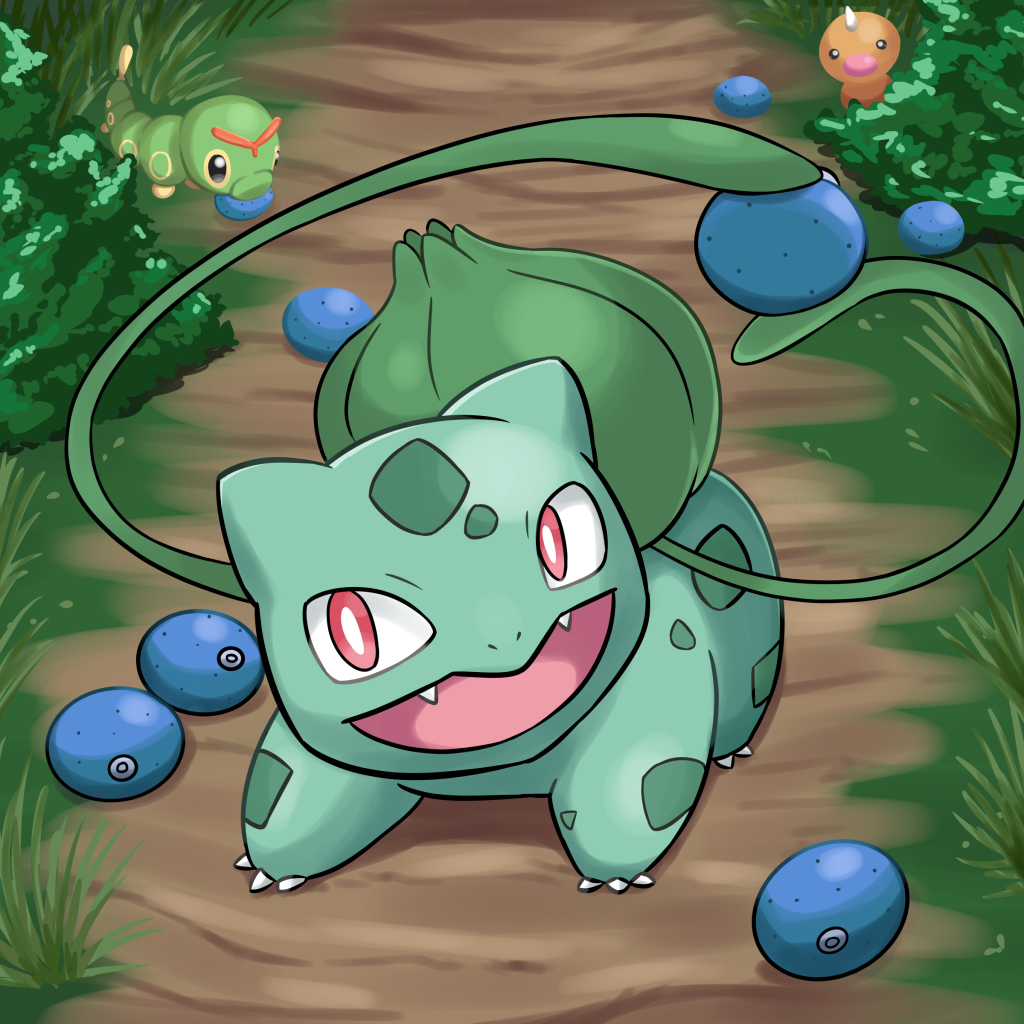
Bulbasaur are typically sensible beings and are known for their caretaking abilities. Mine finds great pleasure in maintaining his (very orderly) garden and looking after my baby niece, Clara. Many a time, I’ve seen him gently rock her cradle and sing the Bulba-by and it brings joy to my heart each time. I think it might be part of their communal nature. If you ever go to Kanto and are lucky enough to happen upon an evolution ceremony, you will know what I mean.
Where to find one
The only chance you’ll get to catch a Bulbasaur in the wild is at their gatherings, which occur once a year. However, I really wouldn’t advise this. A Bulbasaur-Ivysaur-Venosaur community is very wary and secretive. In fact, they can be so elusive that it is extremely difficult for trainers to find the meeting place. Not only are they held in the depths of very hard-to-reach forests, but their groups contain a good mixture of low- and high-level individuals. Those energetic Ivysaur might just decide you could be their next best plaything. And then there’s the all-mighty protectors of the forest, Venusaur, who will no doubt try and chase you off if you cause a stir.
If you do find a gathering, be courteous. I’ve always found if you respect nature, it won’t bother you. That seems to be the case here. I’ve been lucky enough to catch the ceremony once or twice and it is such a spectacle. If you are an experienced trainer and intend on catching a Bulbasaur at one of these events, it is best to wait until after proceedings have died down. Slowly approach a group near the edge of the clearing and clearly state your intentions. If one is willing to take you on, let the battle commence! If not, either ask another group or try again next year. Some things are worth waiting for.
For all but the most experienced trainers, the best way to get a Bulbasaur companion is to talk to a breeder. When you first meet the brood, make sure to look for one of the individuals that is playing with its litter-mates, sunbathing, or energetically undertaking a private hobby. A young Bulbasaur should never be isolated or standing in a corner. If you see this behaviour, please tell the breeder. It may mean they have to alter their training.
Preparing the home
A Bulbasaur’s social life is a complex one. At heart, one caught from the wild is extremely social and caring but they can also be quite aloof and stand-offish. That’s because they live alone or in small family groups for most of the year, in the wild. The gatherings I spoke about are very special occasions.
Don’t be fooled, though. Just because your Bulbasaur is aloof doesn’t mean he doesn’t care. Bulbasaur communities know each individual extremely well. They learn to recognise each other by their unique facial and body markings, as well as their scent, powders, and impressions they make in the grass. So, don’t get too unnerved if your new Bulbasaur stares at you a lot or inspects where you’ve just been sitting on the sofa. He’s just trying to work you out.
Encourage your Bulbasaur to take up a hobby, like gardening.
Image credit: Marta Maszkiewicz.
Speaking of their powders, or spores, be prepared for the house to be covered with them! A Bulbasaur uses its powders as a way of scent marking – the way a cat might mark a couch by scratching or a dog by peeing on a hydrant. That means that in the early days, you won’t be able to go a day without finding it everywhere like white feathery snow. Don’t worry, it’s not poisonous at this stage. However, be sure to train your friend to stop marking the house if you’re planning on teaching him moves like Poison Powder or Sleep Powder.
When introducing a new Bulbasaur to your home, you want to make sure he has his own private space where he cannot be disturbed. This will preferably be in a sunny spot in the garden or by a south-facing window. Buy him a few potted plants and encourage him to care for them, and make sure he has access to rainwater at least once a week. If you live in an arid area, you might want to buy a water butt and save some up for him. Tap water isn’t the worst thing in the world, but they can get a little sickly if they get no rainwater at all.
Raising for battle
Bulbasaur is a grass-poison Pokémon and its fighting moves largely revolve around its vines and powders.
If you want to focus on powder-based moves such as Poison Powder, Sleep Powder, Worry Seed and Seed Bomb, you’ll want to encourage him to scent-mark. To save your house, try picking out a designated training area and place something with his scent on at each corner. You can buy specially generic pre-scented flags from your local Pokémart if that’s easier. Next, you’ll need to familiarise yourself with the types of powder. You can actually use his diet to influence the types produced. Feed him Deadly Nightshade, Castor Bean, or Water Hemlock (these are deadly to humans, so treat with utmost care) to encourage his poison spores, or Lavender and Jasmine to strengthen his sleep spores.
The physical moves like Take Down, Vine Whip, Razor Leaf, and Double Edge will be easier to train. Bulbasaur are quite intelligent and eager-to-please so this should be fairly easy to do with a couple sandbag training dolls, targets and treats.
Keeping Bulbasaur happy and healthy
Whether you’re training for battle or just raising as a pet, it is very important for Bulbasaur to sunbathe. I can’t stress this enough. Being a plant-based creature, one of Bulbasaur’s energy sources is the sun (photosynthesis). Make sure your Bulbasaur gets at least half an hour a day of peak-time sunlight in summer and triple that in winter. If you live in a cloudy, rainy place like I do you could buy an incandescent light but this is in no way a full substitute. Bulbasaur that cannot get enough sunlight must be given nutritional supplements. You can get advice from your local Pokémart’s nutritionist.
As well as light, your Bulbasaur must also eat. He lives on a herbivorous diet of grass, legumes, and leafy greens. Fruit can be given periodically as a treat. Other plant-based things can be ok, too. For example, my Bulbasaur got a peculiar obsession with peanuts for a while. Just make sure that any extra food like this is given in moderation and watch their weight. No one wants a chubby bubby!
As I’ve mentioned, Bulbasaur are usually intelligent and benefit from hobbies. This varies from individual to individual, but activities I’ve seen include gardening, painting, baking, target practice (for particularly avid battlers), and even training other Pokémon! Their vines are quite dexterous and they can be very inventive. If your Bulbasaur is struggling to find something naturally, feel free to suggest some activities he may not have thought about. However, always let him choose and don’t try and force him into it.
Overall
Bulbasaur is said to be great for new trainers due to their devoted, caring nature and their will to please. I generally agree with this sentiment. However, as you have seen, there is a lot more to this bubbly soul and they have some pretty particular needs. Saying that, you’ll find no other Pokémon more willing to work together to overcome any hurdle.
Sleeping Bulbasaur. Image credit: Olivia Bigelow.
Watch out for the first Bulbasaur story on 29th April!
For a Bulbasaur, Ivysaur, Venusaur Sonnet, click here (partner website).
Pokémon are one of the greatest joys in life. They’re our friends, our colleagues and our family. They live beside us so harmoniously nowadays that sometimes it is hard to remember that these are wild creatures at heart. This guide aims to advise you on how to care for your Pokémon, including keeping them healthy, happy and fit. Providing the right level of care is no small feat, as each species has a multitude of different personalities, wants and needs. This is in no way a comprehensive guide – for that you’ll need to take time in getting to know your own Pokémon the hard way – but this will hopefully be a good stepping stone to building that relationship.
In this guide, you will find a combination of care advice and stories. There will be one advice sheet for each Pokémon, including where to find it, how to prepare your home for its arrival, how to keep it fighting fit, and how to make sure it is happy and healthy. In between these, you will find the stories. Some of the these will be my experiences, while some will be tales from the friends I have made over the years, including Pokémon lovers in all sorts of roles. Here, we will share with you the scary times, the epic battles, the sad times and those precious moments we hold dear.
We try and find a perfect match between trainer and Pokémon. Image credit: Marta Maszkiewicz
About me and my Pokémon breeding centre
My journey with Pokémon started many years ago. I, too, started out with wild dreams of fighting my way to the top of the leagues to become the Pokémon Master. Let me tell you, I came close! However, I stumbled onto what I now see as a greater and more difficult task: a Pokémon Breeder. We aim to find a deep understanding of every Pokémon that passes through our centre, from their personality and psychology to their physical and mental needs.
We also try and perfectly match trainer and Pokémon, aiming for healthy, prosperous relationships. Some people that come to our centres are trainers looking for a new battle partner, parents looking for a companion for their children or businessmen seeking working Pokémon. The best breeders are those that are credited by the International Breeder’s Association (IBA). Please be careful to find a registered breeder, as there are too many unlicensed thieves out there who sell mistreated and sick Pokémon that often have behavioural issues. Bandit groups like Team Rocket are also known to be involved, claiming to have ‘trained out’ unwanted traits. No true breeder will make any such claims.
I do hope you enjoy my stories and find them useful on your journey to be the very best.




 A Breeder's Guide to Pokémon