Generation #1 · Generation #1 (1-10)

Venusaur (#3)

There is a sense of mystery around them to which their slow, reflective nature only adds. Image Credit: Takamizawa Usui

Venusaur are mighty and sacred individuals, often nicknamed King of the Forest. Often the star of myths and legends, wild Venusaur often remain motionless for years at a time and only stir at times of crisis.

It was once thought that Venusaur was part psychic type because of its innate awareness of its environment, but scientists are now discovering that Venusaur may be able to connect to the mycorrhizal network of the forest, a connection that can span miles around.

Where to find one

Venusaur are rare in the wild and extremely powerful. On top of this, there is always the moral question as to whether you should catch a wild one. Ivysaur only evolve into Venusaur one at a time and they do so to become protectors of the forest. Scientists are only just discovering just how deeply these Pokémon are connected to their forest homes. Each Ivysaur accepts this special mission and will not be readily prepared to stop its cause.

I have known a few instances where Venusaur capture was necessary. In one awful case, a fire ravaged a whole woodland beyond repair. The council decided to build on the land and turn it into a Pokémon retreat, but the Venusaur in charge of that area was so distraught that he’d let down the Pokémon he was destined to protect, he quickly fell into depression. I, and a team of breeders, was asked to help him. We decided he needed specialist care. We found a trusted trainer to capture him and take him to a therapist. It took him a few years of dedicated care, but the Venusaur is doing well! Last I knew he started his own nursery.

A Venusaur’s power is very hard to tame. It takes a long time for this Pokémon to fully respect you if you catch it from the wild. For all of these reasons and more, I would instead recommend raising an Ivysaur to evolve to Venusaur. Though, I would only advise this for battle purposes. Venusaur is a hard-to-manage breed that have a lot of specific requirements. Think very carefully about the reasons you have for evolving him before doing so. Ivysaur live long, happy lives without needing to evolve and it comes quite natural to them.

Scientists are now discovering that Venusaur may be able to connect to the mycorrhizal network of the forest. Image credit: Marta Maszkiewicz

Raising for battle

Ivysaur evolve to become Venusaur at level 32. After they evolve, they can learn the moves Worry Seed, Synthesis, Petal Blizzard and Solar Beam. Of these, Ivysaur only learns one of these, so there is a benefit to evolving for battle. If you’re planning on delaying, I’d recommend evolving no later than 45 for learning Synthesis. Worry Seed can probably be missed, especially if you’ve kept Bulbasaur’s Sleep Powder and are happy with the accuracy.

Venusaur have immense power and can be a great battle partner. However, long gone are the days of sporty Ivysaur, and your Venusaur will tire very quickly in battle. Don’t use him against anything that uses speed, as you’ll be at a disadvantage. That’s not to say that his moves are slow, just his movement. Razor leaf, Petal Blizzard and Solar Beam are all intense, fast-paced attacks that Venusaur can perform with exceptional accuracy.

Keeping Venusaur happy and healthy

Venusaur need a lot of care, especially when they get older. They often find it difficult to move and will need consistent leg-strengthening exercises to maintain full mobility. It is advisable that you hire a personal trainer for your Venusaur, who will be able to plan a personalised activity plan to meet his specific needs.

If you have raised your Venusaur from an Ivysaur and wish to continue his development, I’d recommend stopping agility course training and begin wellness training. This is a new concept that was helping develop a few years ago. Essentially, a study into Venusaur battle statistics found that young Venusaur who had regular battle training were just as effective in battle as middle-aged Venusaur who had many more years of time to hone their skills. It is thought that by age 53 or so, Venusaur reaches its peak in terms of power. This makes some biological sense, as it is the time when he learns Solarbeam, his most powerful attack.

Wellness training comprises a mixture of grooming (leaf / claw trimming and exfoliating the skin), plant care (using fertiliser, nutrient food additives and carefully planned water / sunlight schedules) and mental development (puzzles, socialisation and work). This might not sound like training, but these all keep Venusaur happy and focused, which have shown some promising results in battle.

It is advisable to take some courses in plant care, as Venusaur’s plant will need similar care to exotic species

Overall

As a breeder, you come to gain a lot of respect for Venusaur and it truly is a miracle to see one. There is a sense of mystery around them to which their slow, reflective nature only adds. Venusaur are immensely powerful Pokémon that need a lot of care. They show great courage in battle, but often get tired and show their age.

It took him a few years of dedicated care, but the Venusaur is doing well! Last I knew he started his own nursery. Image credit: Laurie MacQueen
Generation #1 (1-10)

Bulbasaur (#1)

Bulbasaur
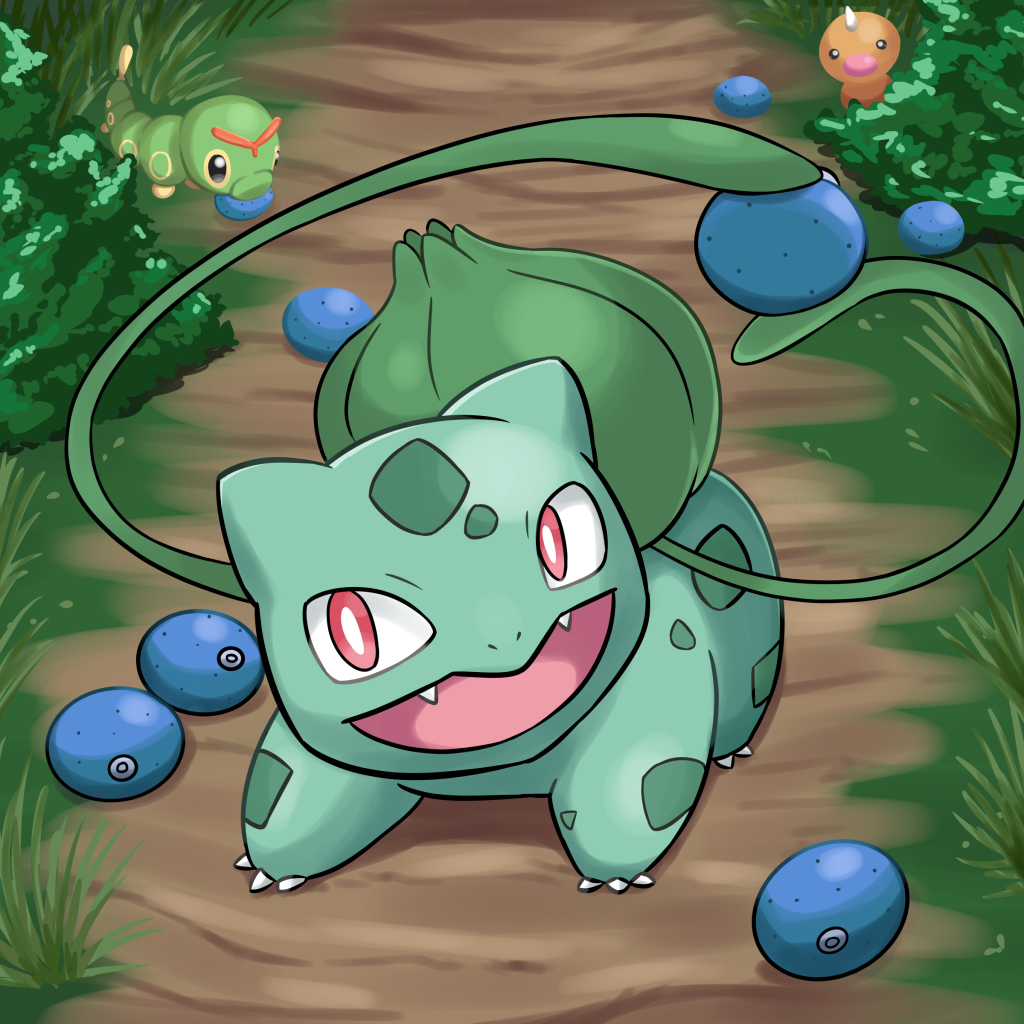
Fruit can be given periodically as a treat. Image credit: Takamizawa Usui.

Bulbasaur are typically sensible beings and are known for their caretaking abilities. Mine finds great pleasure in maintaining his (very orderly) garden and looking after my baby niece, Clara. Many a time, I’ve seen him gently rock her cradle and sing the Bulba-by and it brings joy to my heart each time. I think it might be part of their communal nature. If you ever go to Kanto and are lucky enough to happen upon an evolution ceremony, you will know what I mean.

Where to find one

The only chance you’ll get to catch a Bulbasaur in the wild is at their gatherings, which occur once a year. However, I really wouldn’t advise this. A Bulbasaur-Ivysaur-Venosaur community is very wary and secretive. In fact, they can be so elusive that it is extremely difficult for trainers to find the meeting place. Not only are they held in the depths of very hard-to-reach forests, but their groups contain a good mixture of low- and high-level individuals. Those energetic Ivysaur might just decide you could be their next best plaything. And then there’s the all-mighty protectors of the forest, Venusaur, who will no doubt try and chase you off if you cause a stir.

If you do find a gathering, be courteous. I’ve always found if you respect nature, it won’t bother you. That seems to be the case here. I’ve been lucky enough to catch the ceremony once or twice and it is such a spectacle. If you are an experienced trainer and intend on catching a Bulbasaur at one of these events, it is best to wait until after proceedings have died down. Slowly approach a group near the edge of the clearing and clearly state your intentions. If one is willing to take you on, let the battle commence! If not, either ask another group or try again next year. Some things are worth waiting for.

For all but the most experienced trainers, the best way to get a Bulbasaur companion is to talk to a breeder. When you first meet the brood, make sure to look for one of the individuals that is playing with its litter-mates, sunbathing, or energetically undertaking a private hobby. A young Bulbasaur should never be isolated or standing in a corner. If you see this behaviour, please tell the breeder. It may mean they have to alter their training.

Preparing the home

A Bulbasaur’s social life is a complex one. At heart, one caught from the wild is extremely social and caring but they can also be quite aloof and stand-offish. That’s because they live alone or in small family groups for most of the year, in the wild. The gatherings I spoke about are very special occasions.

Don’t be fooled, though. Just because your Bulbasaur is aloof doesn’t mean he doesn’t care. Bulbasaur communities know each individual extremely well. They learn to recognise each other by their unique facial and body markings, as well as their scent, powders, and impressions they make in the grass. So, don’t get too unnerved if your new Bulbasaur stares at you a lot or inspects where you’ve just been sitting on the sofa. He’s just trying to work you out.

Gardening
Encourage your Bulbasaur to take up a hobby, like gardening. Image credit: Marta Maszkiewicz.

Speaking of their powders, or spores, be prepared for the house to be covered with them! A Bulbasaur uses its powders as a way of scent marking – the way a cat might mark a couch by scratching or a dog by peeing on a hydrant. That means that in the early days, you won’t be able to go a day without finding it everywhere like white feathery snow. Don’t worry, it’s not poisonous at this stage. However, be sure to train your friend to stop marking the house if you’re planning on teaching him moves like Poison Powder or Sleep Powder.

When introducing a new Bulbasaur to your home, you want to make sure he has his own private space where he cannot be disturbed. This will preferably be in a sunny spot in the garden or by a south-facing window. Buy him a few potted plants and encourage him to care for them, and make sure he has access to rainwater at least once a week. If you live in an arid area, you might want to buy a water butt and save some up for him. Tap water isn’t the worst thing in the world, but they can get a little sickly if they get no rainwater at all.

Raising for battle

Bulbasaur is a grass-poison Pokémon and its fighting moves largely revolve around its vines and powders.

If you want to focus on powder-based moves such as Poison Powder, Sleep Powder, Worry Seed and Seed Bomb, you’ll want to encourage him to scent-mark. To save your house, try picking out a designated training area and place something with his scent on at each corner. You can buy specially generic pre-scented flags from your local Pokémart if that’s easier. Next, you’ll need to familiarise yourself with the types of powder. You can actually use his diet to influence the types produced. Feed him Deadly Nightshade, Castor Bean, or Water Hemlock (these are deadly to humans, so treat with utmost care) to encourage his poison spores, or Lavender and Jasmine to strengthen his sleep spores.

The physical moves like Take Down, Vine Whip, Razor Leaf, and Double Edge will be easier to train. Bulbasaur are quite intelligent and eager-to-please so this should be fairly easy to do with a couple sandbag training dolls, targets and treats.

Keeping Bulbasaur happy and healthy

Whether you’re training for battle or just raising as a pet, it is very important for Bulbasaur to sunbathe. I can’t stress this enough. Being a plant-based creature, one of Bulbasaur’s energy sources is the sun (photosynthesis). Make sure your Bulbasaur gets at least half an hour a day of peak-time sunlight in summer and triple that in winter. If you live in a cloudy, rainy place like I do you could buy an incandescent light but this is in no way a full substitute. Bulbasaur that cannot get enough sunlight must be given nutritional supplements. You can get advice from your local Pokémart’s nutritionist.

As well as light, your Bulbasaur must also eat. He lives on a herbivorous diet of grass, legumes, and leafy greens. Fruit can be given periodically as a treat. Other plant-based things can be ok, too. For example, my Bulbasaur got a peculiar obsession with peanuts for a while. Just make sure that any extra food like this is given in moderation and watch their weight. No one wants a chubby bubby!

As I’ve mentioned, Bulbasaur are usually intelligent and benefit from hobbies. This varies from individual to individual, but activities I’ve seen include gardening, painting, baking, target practice (for particularly avid battlers), and even training other Pokémon! Their vines are quite dexterous and they can be very inventive. If your Bulbasaur is struggling to find something naturally, feel free to suggest some activities he may not have thought about. However, always let him choose and don’t try and force him into it.

Overall

Bulbasaur is said to be great for new trainers due to their devoted, caring nature and their will to please. I generally agree with this sentiment. However, as you have seen, there is a lot more to this bubbly soul and they have some pretty particular needs. Saying that, you’ll find no other Pokémon more willing to work together to overcome any hurdle.


Sleeping Bulbasaur
Sleeping Bulbasaur. Image credit: Olivia Bigelow.
  • Watch out for the first Bulbasaur story on 29th April!
  • For a Bulbasaur, Ivysaur, Venusaur Sonnet, click here (partner website).